There are two main hormones which regulate the female menstrual cycle: oestrogen and progesterone.
These hormones ebb and flow in varying amounts which feeds back to the brain, and forward to the ovaries and uterus, to dictate what stage of the cycle your body is at (such as growing the uterine lining to prepare for fertilisation, triggering egg release at ovulation, or shedding the lining if fertilisation doesn’t occur).
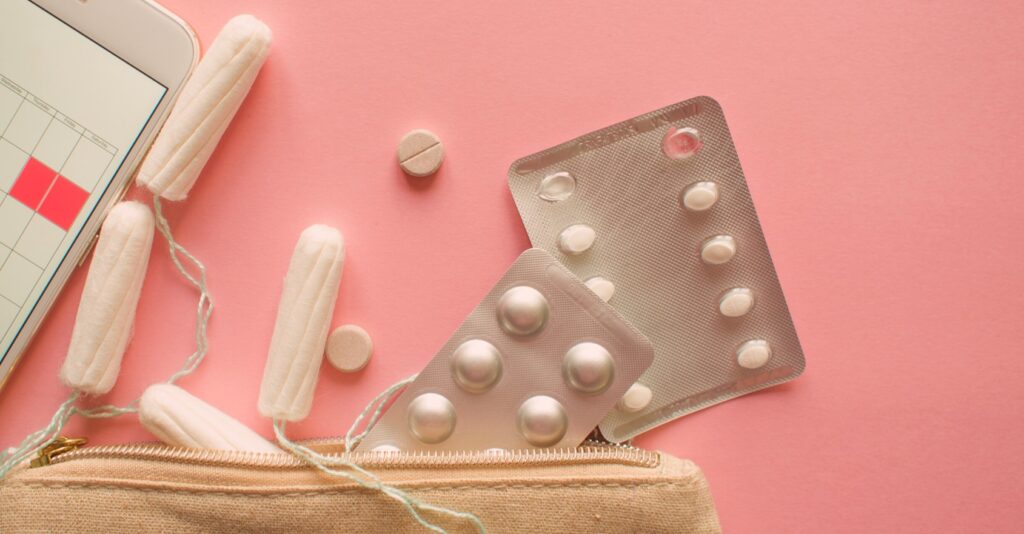
Any hormonal contraceptive available works on one or both of these hormones in some way to disrupt this complex signalling. The oral contraceptive pill (referred to as the OCP, or sometimes as ‘the pill’) uses both oestrogen and progesterone to keep hormone levels higher in your body. This will prevent ovulation, as there are no fluctuating hormonal signals to trigger it. The uterine lining stays stable as a result, and no period occurs. However, if you decide to take the sugar pills (which have no active hormones), you will bleed – but this is due to the withdrawal of the hormones which are keeping the uterine lining alive, and so is more of a manufactured period than a natural one.
Alternatively, some contraceptives that use progesterone only (such as Mirena, Implanon, depot injections, or the progesterone-only pill (or ‘mini-pill’)) work by preventing the uterine lining from building up in the first place. This is why, after several months of using one of these contraceptive types, some people notice their periods tend to lighten, and they may go away altogether.
However, not every person is the same, and some may find that their bleeding becomes heavier or more irregular on some types of contraceptives. If this is annoying or worrying to you, see your doctor to discuss other options available to you.
Thank you to our guest contributor, Dr Madeleine for clearing this up for us!
If you want more information about your contraception options or help finding a contraception service, contact 1800 My Options on 1800 696 784, weekdays 9am – 5pm.
5 Things I Wish I Learnt in Sex Ed
One of our team members reflects on what sex ed was like, and what she’s learnt since.
Growing up in the dark ages, the sex education I received was pretty much non-existent. I have vague recollections of an awkward ‘film’ night in late primary school where you and your mum (Dads were nowhere to be seen) got to watch a really bad sex ed documentary together with your classmates. In secondary school we learnt about the reproductive organs in biology but nothing fun like putting condoms on bananas. That, combined with a cringey 10-minute talk from Mum about periods was pretty much the extent of my formal sex education.
Instead, I relied on questionable information from my peers and my own sexual (mis) adventures to try and work it all out. The result? Lots of unpleasurable and unsafe sex, exposure to STIs, risk of unplanned pregnancy, feelings of shame and many unhealthy and unsafe relationships. The heavily misogynistic and homophobic world of my youth also played a role. Nothing beyond the hetero-cis norm narrative was acceptable. As a young cis woman, the message I received about sex was loud and clear: your pleasure and needs don’t count. It’s all about the man.
There are so many things I wish I had known then that I do now. If I could go back in time, these are the just 5 of the things I wish I had learnt as part of my sex education:
Consent to any sexual activity is enthusiastic, clear and can be withdrawn at any time.
Using barrier methods like condoms and dams are important to help prevent the transmission of STI’s and other potential health issues.
If one type of contraception doesn’t suit you, there are others available that might be better suited. Explore your options!
Sex (in all its forms) is natural and fun and is way more than just penetration.
Sexuality is a spectrum – lesbian, gay, bisexual, transgender, queer, questioning, intersex, asexual, pansexual, heterosexual or no labels at all. Be proud of who you are.
What every international student should do before coming to Australia?
As exciting and overwhelming as things can get, from purchasing your flight tickets, to figuring out where to stay, getting from point A to B, as well as managing between your ‘O’ week and class schedule.
As an international student, it can get pretty hectic but it’s also good to keep in mind what can be done when first arriving in Australia – to ensure you’re on top of things. Some of them may include:
1. Familiarising yourself with your private health insurance policy
Your Overseas Student Health Cover – OSHC is your private health insurance which can help with covering costs related to medical treatment, hospital care, and some prescription medications you might require during your time as an international student in Australia.
There are numerous plans available for you, from insurance providers such as NIB, BUPA, Allianz, Australian Health Management or Medibank. It can get overwhelming to have so many options, but if ever in doubt – give them a call directly and find out which plan best suits you.
Familiarise yourself with your insurance policy and ask about waiting periods and exclusions or limitations. This is crucial to know especially when pregnancy-related care is usually not part of your insurance cover during your first 12 months arriving in Australia.
2. Payment options
Some payment options for treatment and medication can include
paying the healthcare provider directly and get your OSHC provider to refund the cost or
go to a clinic that does ‘direct billing’ with your insurance provider, which can significantly reduce any payment you make for the appointment. You might have to check prior with your OSHC provider or with the healthcare provider themselves, to see clinics which may have an agreement to do ‘direct billing’ close to your area.
Your insurance plan can also determine whether you might incur extra costs for some services – better known as “out of pocket” or a “gap fee”. For more information, please click here.
3. Know your medical rights
In Australia, your medical information is completely confidential and no one else can have access to it, without your consent. Abortion and contraception are both safe and legal, and are available for you at any time.
4. Get to know your what health services your education provider
Don’t hesitate to check with your university or college as you would be surprised that many of them can offer on-campus healthcare options including sexual health checks ups, assessments and women’s health care.
10 SRH-related activities for end of lockdown
Easing yourself out of lockdown? Have a look through our list of 10 sexual and reproductive health-related activities!
Try a new period product
What better time to check if a new period product works for you than before we fully launch ourselves back into society? A whole heap of more environmentally-friendly period products have become available over the last few years – such as menstrual cups, period underwear and reusable pads. You might end up finding one of these methods are more comfortable, cost-efficient and greener than regular disposable pads and tampons.
Watch some Netflix
Thought you’d finished Netflix? Try watching some of our favourite sexual and reproductive health-related media – like the hilarious and educational series Sex Education (season 4 just dropped!). Or, if you’re hungry for non-fiction, try the documentary “Period. End of Sentence” about entrepreneurial women in India who shed taboos around menstruation, or “Reversing Roe” about the terrifying bid to restrict abortion access in America. Get the microwave popcorn ready, and invite a friend over!
Go through your bedside table
Are you prepared for any exciting post-lockdown sexual adventures? This means cleaning your sex toys (with mild soap and warm water), chucking out any expired condoms and lubes, and ordering yourself some more!
Decorate
Did you spend too much time staring at the same, boring walls over the past few months? Why not hang up some gorgeous feminist prints – like these prints by Michelle Pereira at the Victorian Women’s Trust, or Yarli Creative’s “Birthing the Matriarch” print!
Colour in
Host a crafternoon – whip out the crayons and pencils and have a go at Tee Corrinne’s ‘Cunt Colouring Book’ – featuring “over 3 dozen cunts of every size and description for you to colour. Originally used for a sex education class.” It’s mindfulness meets labia.
Give back
If you’re thinking about a generous donation to a charity, why not look at some sexual and reproductive health-related ones? The International Planned Parenthood Federation fight for sexual and reproductive rights worldwide, and donating can help them provide family planning, maternal health care, HIV care, prevention and other vital services to the people who need them most – poor, young, vulnerable and under-served. Closer to home, Australian charity Share the Dignity distributes period products to those doing it tough. You can help them end period poverty through donating money or period products in one of their collection drives.
Consider your (contraception) choices
This might be a good time to reconsider what contraception methods might work best for you. Take the time to research all available options on reputable sites (like ours!) and book in for a telehealth consult with a doctor or sexual health nurse. You can even do an online quiz to see which contraception options might suit you!
Read a book
Learn about the history of abortion activism and access in Australia through the collection “Choice Words” (edited by Louise Swinn), or through reproductive rights activist and rebel doctor Caroline de Costa’s autobiography “The Women’s Doc.” Want to learn how a menstrual revolution is the key to unlocking gender equality? Then “About Bloody Time” (by Karen Pickering and Jane Bennett) is the read for you.
Book in
Is it time for your yearly STI check, or are you behind on Cervical Screening Testing? While it’s easy to put aside your sexual and reproductive healthcare during lockdowns – medical care is always an essential reason to leave home. If you need help finding a GP or sexual health clinic near you, give us a call on 1800 696 784 (weekdays) or use our online search.
What happens if I have a Positive Cervical Screening Test result?
We hear about getting our first Cervical Screening Test at 25 a lot, and now we can just do the test ourselves! But what does the test actually look for? And what does it mean if you have an ‘positive’ result?
The CST – which is now a swab you can self-collect from inside the vagina – tests for the presence of Human Papilloma Virus (HPV). After your sample gets sent to the laboratory, there may be a chance that it returns an ‘positive’ result.
Let’s break down what this can mean.
Human Papilloma Virus (HPV)
HPV is a highly contagious viral infection with over 200 types. Most people who have ever been sexually active will have HPV at some point in their lives, meaning almost everyone can and will have had HPV – no matter if you have a vagina or penis.
Most of the time the infection is invisible, harmless and goes away without causing any issues. However, some types of HPV can cause a variety of cancers and warts.
Cervical cancer is a rare outcome of an HPV infection. It takes about 10 to 15 years for cervical cancer to develop after an HPV infection. 95% of cervical cancers are associated with HPV infection.
Negative and Positive results
If your swab comes back “negative” – meaning it does not find any HPV – you won’t need to test again for another 5 years.
A “positive” result means that you have a HPV infection. This does not mean you have developed cervical cancer.
There are a few things that can happen next:
Cervical screening
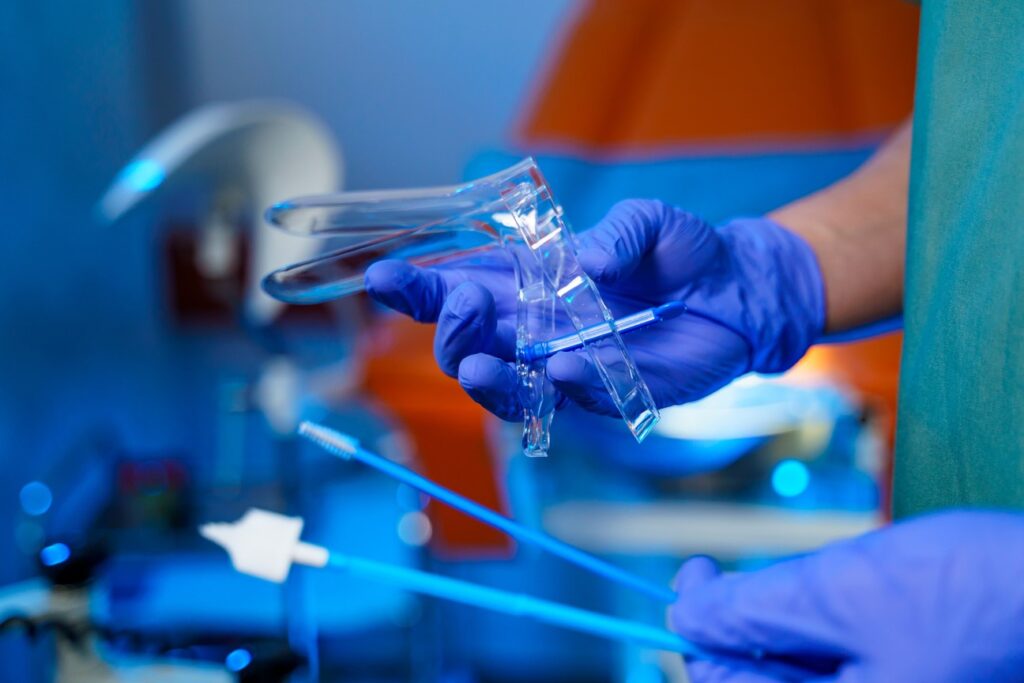
If you self-collected your sample, your healthcare provider will want you to come in for a full cervical screen. This involves the insertion of a speculum, looking at your cervix and taking some additional samples to be sent to the lab. If any abnormal cells are detected in these samples, or if you have had 2 or more occasions of having abnormal cells detected, you may be referred to a specialist.
Wait and see
You may be told to wait, so your body has time to clear the infection (most HPV infections are cleared by the body within 1-2 years). You may need re-screening at 12 months but are unlikely to need any treatment to the cervix.
Specialist referrals
In some cases, you will be referred to either a public hospital or private gynaecologist for a colposcopy. This may be due to the presence of certain types of HPV – such as HPV strains 16/18 – which are more commonly linked types to cervical cancer. A colposcopy will check for any abnormal cervical cell changes.
What is a colposcopy?
A colposcopy looks closer at the cervix and helps to determine the nature of abnormal cervical cells.
Like how a CST is performed, you will also need a speculum inserted into your vagina so they can see your cervix clearly. Then, they will use a magnifying glass called a colposcope, which looks like a pair of binoculars mounted on a stand. This does not touch the body.
During the colposcopy the doctor will apply different solutions to the cervix to see which areas need to be test, and if there are any changes to the cervix.
If there are any areas they think need further testing, they may take a small biopsy of some of the cervical cells. This is like a pinch, but should not cause significant pain. These tissues will then be sent off for testing. Afterwards, you may feel some cramping but it is safe to continue with your day.
Cervical abnormalities
Persistent HPV infections can cause abnormal cells to develop on the cervix.
Your colposcopy results will give you more information about any abnormal cells in your cervix.
Abnormalities just mean the cells of the cervix appear different – this does NOT automatically mean you have cancer. Abnormalities can usually be treated easily and successfully, if detected early. If left untreated, there is a greater chance of developing cervical cancer.
Cervical abnormalities are given different grades of severity:
Low-grade abnormality
This means that the cells of the cervix are slightly changed, and can confirm infection with HPV. Often your body is given time to clear the infection – as most HPV infections are cleared by the body within 1-2 years. You may need re-screening at 12 months, but are unlikely to need any treatment to the cervix.
High-grade abnormality
This means that the cells of the cervix have gone through greater changes. This is due to an HPV infection that has not been cleared by your immune system. These changes will be followed up by the public hospital or private gynaecologist for further testing and possible treatment to the cervix.
Finally, if you develop any bleeding after sex or between your periods, develop pelvic pain or deep pelvic pain during sex or if you notice any other symptoms you’re worried about see your doctor. While most infections with HPV are symptomless and while most cervical cancers are caused by HPV there are other rare types of cervical cancer that cannot be detected with a CST. Act on these symptoms and see your doctor or nurse.
Key messages:
Everyone will have HPV at some point in their lives
Most HPV infections will clear themselves within 1-2 years
If you have HPV on your swab, you will need a health professional to collect a cervical screen to test for abnormal cells
Depending on your results, you may need to return for a test in 12 months or see a specialist for a colposcopy
Abnormal cell changes can be classed as low grade or high grade
High grade changes may require treatment
If you have any bleeding after sex or between your periods see your doctor for testing and examination
For more information on what is involved in the initial CST, read our blog post here!
Can abortion affect your fertility?
This is a question we get asked a lot! This International Safe Abortion Day, we ask guest contributor, Dr Madeleine, to share her thoughts on this common anxiety.
Many women opting for an abortion are concerned that their fertility may be affected in the future. Generally speaking, abortion does not impact your fertility! In fact, some people can get pregnant quite quickly after an abortion. However, there are some rare exceptions to be aware of, which I’ll detail below.
Women having an abortion typically have two main options: medical termination of pregnancy (which uses a medication to induce abortion), or surgical termination of pregnancy (which uses a surgical instrument to remove the lining of the uterus and the pregnancy material). Both are very safe, and the vast majority of women have no issues.
For reference, medical termination used up to 9 weeks’ gestation is approximately 95.1 – 97.7% effective. In an Australian study, only 4.8% of women having medical abortion required a surgical procedure as a follow up, most commonly due to a retained clot. The rate of infection after medical termination is 0.01%, and need for blood transfusion is 0.03%.1 Surgical termination is generally estimated as over 97% effective.2 Some tissue can remain in approximately 0.4% of cases, requiring a repeat procedure. Serious risks like trauma to the cervix or damage to the uterus are extremely rare – approximately 0.001% – that’s one in one thousand.3
Regarding other extremely rare complications, there are two significant issues that may develop and later affect fertility. To emphasise, both are rare, and more associated with surgical termination. These are known as Pelvic Inflammatory Disease (PID) and Asherman’s Syndrome.
PID is caused by infection which ascends from the vagina into the uterus, and sometimes up to the fallopian tubes. This can cause scarring of the tubes, which may lead to problems fertilising the egg. PID is usually caused by STIs like chlamydia, or sexually-associated infections like bacterial vaginosis – yet another reason why it’s important to have regular screening for STIs! You may wish to discuss STI screening with your doctor prior to an abortion.
Asherman’s Syndrome is when scarring develops between the walls of the uterus or the cervix in response to having the lining of the uterus removed. This can cause the walls to stick together and decrease fertility. However, this is associated with having had multiple surgeries on the walls of the uterus (at least more than two), and is treatable.
As with any medical procedure, there are small associated risks.
As a comparison, birth itself can involve many risks: in Australia, the rate of major tearing with a vaginal birth was 2.9% in 2018,4 Caesarean section rates are over 30%,5 and up to one in three women experience acute trauma symptoms after birth.6Even though medical and surgical terminations are low-risk procedures, your doctor should speak with you in detail about potential problems and you have the right to ask as many questions as you like.
If a woman has had a termination because of problems with the developing baby, and wants to get pregnant again, she can usually try again after her next normal period. Otherwise, some form of contraception is advised to prevent further pregnancy.
You can contact 1800 My Options for support finding abortion and contraception options that suit you – call us on 1800 696 784, or email [email protected]
1. Mazza, D et al 2020, Medical abortion, Australian Journal for General Practitioners, The Royal Australian College of General Practitioners (RACGP). Accessed 9 Sep 2021, www1.racgp.org.au/ajgp/2020/june/medical-abortion
2. Lui, MW & Ho, PC 2020, First trimester termination of pregnancy. Best Practice & Research Clinical Obstetrics & Gynaecology, 63, 13-23. https://doi.org/10.1016/j.bpobgyn.2019.06.004
6. Creedy, DK, Shochet, IM, & Horsfall, J 2000. Childbirth and the development of acute trauma symptoms: incidence and contributing factors. Birth (Berkeley, Calif.), 27(2), 104–111. https://doi.org/10.1046/j.1523-536x.2000.00104.x
What happens at an STI test?
Getting a sexual health test can seem a bit awkward – but try not to be embarrassed. The doctors and nurses who provide sexual health testing have seen and heard it all before! Most people will get an STI at some point in their lives and getting tested regularly is an act of self-care and means you’re taking care of your health and the health of your partner(s) and community.
The health professional you see will take a sexual health history. These questions are to help figure what sort of testing to have and the possibility of you having an STI. Some of the questions they might ask include:
When was the last time you had sex?
In last 3 months how many partners have you had?
What sort of sex do you have? (anal, oral, vaginal, with sex toys)
Do you use condoms?
How often do you use condoms? (eg. 50% of the time, 100% of the time)
When was your last period?
Are you using any contraception?
Are you experiencing any symptoms? (change in discharge, itch, lumps or bumps, bleeding after sex etc.)
Has anyone contacted you to let you know they have an STI?
If you are experiencing symptoms the health professional can do a genital examination and testing for you. You can stop this at any time or you can request not to have an examination. If you have symptoms and the health professional you see thinks they are most likely to be caused by an STI, you may be offered treatment before your test results come back.
If you aren’t experiencing any symptoms you won’t need a genital examination. You might pee in a cup, self-collect a vaginal swab and/or anal swab and possibly get a swab of your throat.
You can get also a blood test where they’ll usually take just one tube of blood.
Then just wait for your test results! (sometimes this can be trickier than the testing itself!).
To find a service near you that provides STI testing, contact us – on 1800 696 784, weekdays 9am – 5pm.
Contraception – What If I Have Side Effects?
Contraception can be a wonderful tool, in preventing unplanned pregnancy or managing many medical conditions. However, many people are worried about using contraception, due to a fear of potential side-effects.
Contraception can cause side-effects in one person and no side-effects in another. Unfortunately, it is highly variable. What you experience may be completely different from what your friend or sister experiences, on the exact same contraception! Generally, if you are experiencing side-effects, they usually settle within 3-6 months of using the contraception. However, if the side-effects become too much to tolerate, it is your right to ask for another contraception option.
Weight gain
As it relates to contraception, some people may fear weight gain, some may desire it, and others may not consider it important at all. Sometimes, it’s not so much that a person is gaining weight – it’s that the contraception may cause minor bloating and/or changes to the amount and distribution of body fat to areas where previously it wasn’t. It’s hard to know if you will be affected by this or not.
Bleeding
There are some contraception options that are known to cause irregular bleeding, make your bleeding a bit lighter or heavier, or stop your bleeding altogether. It’s about what you prefer, or can manage. Often times, bleeding will settle down within 6 months of a new contraception – especially for most long acting hormonal contraception options, which many people use to regulate bleeding. But if your bleeds are worsening or not changing, or if they’re causing low iron and/or low energy it’s worth getting checked by your doctor.
Mood changes
When a person uses hormonal birth control, it can alter the level of hormones in their body, which could possibly cause changes to their mood. However, it’s important to recognise that other social and environmental factors can be at play. To reassure those who have mental health conditions such as depression, hormonal contraception has not been associated with worsening of symptoms. Some forms of contraception may increase the risk for being diagnosed with depression, but effects on mood are mixed, can vary by type and whether the hormone goes throughout the whole body or acts locally on the uterus/ovaries.
No matter what, it’s your body and your choice. Finding the right type of contraception for you can take time, patience and trial and error. But you know what’s best for you – so don’t be afraid to voice any of your concerns to your health professional.
Why This Sexual Health Nurse Loves Her Job!
I didn’t start my nursing degree knowing exactly what sort of nurse I wanted to be. I became passionate about sexual health nursing about 2 years into my career. I have always had a passion for “women’s health,” but little did I know where that would take me! I started my Masters of Public Health and fell in love with the microbiology of sexually transmitted infections and STI control theory, but mostly the social determinants at play in who was getting STIs and why.
While I still love the microscopic details of how a bacteria gets into a cell and the way treatments work, the best part of my job is being able to normalise and destigmatise sex and sexuality. To take the shame and secrecy out of sex. To support people who may never have been able to discuss something with anyone else and give them that time and respect.
My favourite part of the job is the talking. I’ve seen enough genitals, heard enough details about symptoms and types of sex, that none of it phases me. It’s talking to the person and helping them feel good about their sex and sexuality that has the biggest and best impact.
Sex is supposed to be fun and enjoyable and connect people – otherwise people wouldn’t do it. It’s about enjoying ourselves safely and with care for each other and ourselves. STIs are gonna happen – so let’s take the blame, shame and secrecy out of it.
I’ve been a qualified sexual health nurse for almost 5 years now and I can’t see myself doing any other job!
Join our mailing list for the latest news
Stay up-to-date with the latest from 1800 My Options. Please note, by providing your details below, you acknowledge that you have read and agree to abide by our privacy policy and terms and conditions.