
1800 696 784
1800 696 784

National Relay Service
Interpreter: 13 14 50
Open 9am-5pm Mon to Fri (closed public holidays)

[email protected]
For emergencies, please call 000

All About Chlamydia

Chlamydia remains the most common bacterial sexually transmissible infection worldwide – so we’ve got LOTS to say about it!

(It also happens to be the infection one of our team wrote their thesis on, so…read on!)

The infection

Chlamydia trachomatis (CT) is the scientific name for chlamydia. This gram negative bacterium enters and infects the epithelial cells, which make up the vagina, cervix, urethra, anus and penis as well as the throat and eyes (although infection in these last 2 are a little rarer).

Transmission

It is commonly transmitted through oral, vaginal and anal penetrative sex. It can also be transmitted through genital-to-genital contact – sometimes known as frottage. Semen (or cum) does not have to be present to cause an infection.

Symptoms

The most common symptom of Chlamydia is having no symptoms! This is known as being asymptomatic. An asymptomatic infection is only revealed by active, regular testing (get an STI test done at least yearly, if not 3-6 monthly).

Symptoms of chlamydia in people with vaginas can vary, but the ones to look out for are bleeding after sex and unusual bleeding, pelvic pain, pain during sex, urinary frequency or urgency as well as painful urination. The big one to watch for is vaginal discharge change – this can be initial change that then clears up, continues or can lead to things like thrush and bacterial vaginosis because the environment of the vagina has been thrown out of whack by the chlamydia.

Complications

If left untreated, infection can result in pelvic inflammatory disease (PID), ectopic pregnancy, chronic pelvic pain and tubal infertility in women and people with uteruses. BUT – not everyone that gets chlamydia will experience these complications. Just getting the infection does not mean your fertility is at risk. Once it’s diagnosed, it can be readily and easily treated!

Treatment

Treatment is relatively straight forward. Most often, if you have an uncomplicated or asymptomatic chlamydia infection, you’ll be offered a once-off dose of an antibiotic. If you’re symptomatic or have the infection in your anus you might be put onto a 7 day course of antibiotics. Your doctor will discuss which treatment will suit you best. Most importantly, after treatment, you should avoid any sexual contact for 7 days. This is to allow the medication to work effectively and prevent re-infection from untreated partners.

Testing

Often you’ll be offered a urine pot which makes it relatively quick and easy – just pee in the cup. You can also self-collect a high vaginal swab instead. This way of testing is actually more sensitive and specific than urine and there’s no pressure to pee on demand! You just insert the swab as high up as a tampon, give it a little swirl around, remove it and then place in the tube. Same goes with the rectal swabs – self-collection is often easier and less uncomfortable in many ways.

Re-test at 3 months to exclude reinfection (as reinfection rates are high!) but don’t re-test for chlamydia too soon! If you test again within 4 weeks you could still come up positive because the test finds Chlamydia DNA even if it’s non-viable (treated and “dead”) Chlamydia DNA.

Talking

It’s important to avoid getting re-infected and to protect yourself and your sexual community. The best way to do this is to let your sexual partners know and ensure they get tested and treated too. Repeat infections in quick succession can cause inflammation and can cause scarring that leads to infertility. It’s ok to get chlamydia multiple times in a lifetime – it’s just important that it gets tested and treated as soon as possible. Talk to your partners about regular testing and use condoms as much as possible.


We hope that Chlamydia 101 has been helpful! Get tested, get treated, get talking.

To find an sexual health service near you, contact 1800 My Options on 1800 696 784, weekdays 9am – 5pm!


Explainer: The abortion “post-code” lottery

What is the abortion “post-code” lottery, and what can we do about it?

The term “post-code lottery” refers to the fact that where someone lives can often determine the availability and quality of healthcare services they can access. Simply living in the “wrong” city, town, or even street can make a difference in what healthcare services you can access, or whether you can access it publicly or privately.

When it comes to abortion and other sexual and reproductive health services, this post-code lottery can be even more obvious. In some countries such as the US, the abortion post-code lottery is dramatically visible, as abortion is criminalised in certain states.

In Victoria however, there is still an abortion post-code lottery. This is for a combination of reasons:

People seeking essential healthcare services such as abortion should not need the luck of the post-code lottery on their side. Some ways that we can address the abortion post-code lottery can include:

While abortions are safe and legal in Victoria, there is clearly still work to be done to ensure that abortion access is equitable for everyone, regardless of where they live.

If you need help finding an abortion service, contact 1800 My Options – weekdays, 9am – 5pm, on 1800 696 784.

How does a medication abortion work?

Medication abortions (also called Medical Terminations of Pregnancy – MTOP) are a popular and safe method of abortion.

This week, our guest contributor Dr Madeleine explains how exactly a medication abortion works, and addresses some common questions people have about them.

There are two main methods available in Australia to induce an abortion (also known as a termination of pregnancy (TOP)).  These can be surgical (STOP) or medical (MTOP). Your medical professional may recommend one over the other, due to factors including your gestation, your previous medical history, and your own desires for your healthcare experience. If you are considering a medical termination of pregnancy, and would like to learn more about how it works and what to expect, read on below.

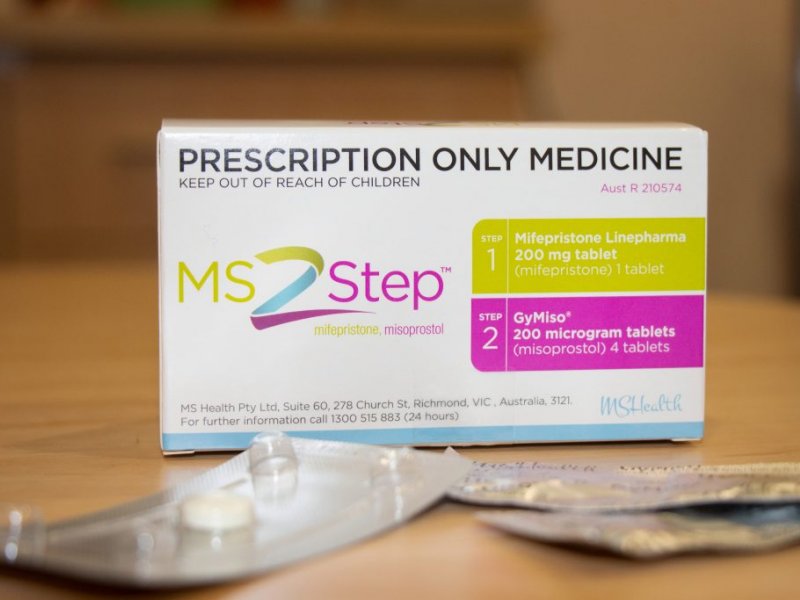
MTOP is usually performed as a two-step process, either at home with the MS2Step medications prescribed by an accredited medical professional (available up to 9 weeks’ gestation)1, or as an inpatient in a hospital. Prior to being prescribed the medications required for an MTOP, you will need to have an ultrasound to confirm the pregnancy is inside the uterus, and a blood test to measure your pregnancy hormone and to determine your blood group2.

Photo of Ms2Step Medication

The first step of the termination itself is a medication named mifepristone, which acts to block the action of the hormone progesterone. Progesterone is important in maintaining the lining of the uterus in pregnancy, so mifepristone acts to stop the pregnancy from progressing. It also starts to soften the cervix to help allow passage of the products of the pregnancy through at the second step3. Some women may have a degree of vaginal bleeding and some nausea and vomiting after taking mifepristone, and a few women (approximately 3 in 100) will have a complete abortion after taking this drug4.

The second step, taken 36-48 hours later, is a medication called misoprostol. This further softens the cervix, as well as induces contractions of the uterus to help expel the products of the pregnancy4. The first dose of misoprostol is usually given orally if undertaking MS2Step at home, or can be inserted vaginally if given as an inpatient in hospital. Women undergoing MTOP can anticipate heavier vaginal bleeding and some painful abdominal cramping after taking the misoprostol step; most people will pass the products of pregnancy within 3-4 hours2. Use pads and simple pain relief as you need. However, if pain is severe and you are worried, or if you find your bleeding is very heavy (for example, you have fully saturated a pad every hour for a couple of hours), you should present to your nearest Emergency Department for assessment. There is also a 24-hour MS2Step hotline you can call for advice.

You should see your GP within a few weeks after the procedure for a follow-up; if you have concerns about ongoing heavy bleeding, smelly vaginal discharge, or fevers and chills, see your GP sooner. Around 95% of women up to 9 weeks’ gestation will have a complete abortion using MTOP3. However, in a small minority of cases (approximately <5%), further intervention may be required due to ongoing heavy bleeding or ongoing pregnancy3.

Overall, a medication abortion when compared to a surgical approach can make abortion “earlier, more accessible, safer, less traumatic, less medicalised and less expensive”5, and fulfils an important demand in Australian healthcare.


Telling your partner(s) you have an STI

Sexually Transmissible Infections (STIs) are a normal part of having sex and yet it can still be a tricky part of relationships.

Openly discussing sexual health is not something we are taught to do, but it’s an important part of caring for ourselves and others. It’s important to break down the unnecessary shame and stigma associated with STIs—this stigma causes increased rates of STI transmission, prevents people from getting treatment, and negatively affects people’s health and sexuality.

If you are able to discuss the situation openly and honestly, this can strengthen relationships and lead to a great foundation for communication around sex and sexual safety. People fear the possibility of rejection but the reality of this is that it rarely happens.

It can be helpful to reassure people that all STIs are treatable, and most are curable. For some STIs, using condoms, dental dams, medications or avoiding sex during outbreaks can limit the risk of STI transmission.

The reality is, most people will want to know if they’re at risk of an STI, so they can prevent passing it back and forth with you and/or passing it on to others. They may not have even realised that they had an infection, as most STIs don’t have symptoms. Once they know, they can get tested and treated, and look after their health.

The key bits of information you need to know if you get diagnosed with a bacterial STI like chlamydia, gonorrhoea or syphilis are:

  1. Notify partners both past and current, how far back to go depends on which STI you have and when you were last tested (eg. chlamydia is 6 months and gonorrhoea is 2 months)
  1. Avoid sexual contact until you have been treated
  1. Wait the full 7 days after treatment to resume sexual contact
  1. Wait the full 7 days until after your partner(s) have had the treatment

This is to prevent passing the infection back and forth. Repeat infections can lead to more serious complications and risks to fertility. Ensuring partners are tested and treated is an important way of controlling the spread of infections in the community as a whole.

For herpes there’s some great information and conversation starters from the New Zealand Herpes Foundation under the heading “herpes and relationships” as telling your partner(s) can often be the most difficult part of a herpes diagnosis.

There are websites with examples of conversations and that allow you to send an SMS or email to your partner(s) directly from the site, either personally or anonymously or if you prefer, you can ask your doctor or nurse to help. You don’t even need to provide your name or contact details to use these free and confidential services.

To appropriate from another campaign: it’s a little bit of awkward telling a partner about an STI …for A LOT of peace of mind for your sexual health and relationships going forward!

Top 5 STI myths busted

About 16% of people will report having an STI in their lifetime. That’s one in six people in Australia!

Certain types of STIs have increased in our communities lately, including gonorrhoea (which tripled between 2008 and 2017), and syphilis (which doubled from 2004 to 2017). To keep you as STI-safe as possible, read on as we myth-bust the top five most common misconceptions about STIs with Melbourne doctor, Dr Madeleine.

1. “STIs always show symptoms.”

Symptoms of STIs can include itch, developing a rash or sores on your genitals, unusual discharge and pain passing urine. In people with uteruses, you may experience pain in the lower stomach, and have bleeding after sex or between periods. People with testicles may experience pain in this area.

However, many infections are completely asymptomatic – one study estimated 45% of gonorrhoea cases and 77% of chlamydia cases didn’t present with symptoms! Viruses such as HIV and Hepatitis C often cause infection silently, and can present for the first time years later with life-threatening illness.

As such, it’s important to have STI screening regularly even without symptoms, and to discuss your risk profile with your doctor so you can be tested appropriately. We recommend screening every 6 to 12 months, or more often if you have a new partner or a frequent change in partners.

2. “STIs are only transmitted via penetrative sex.”

STIs can be transmitted with any sexual act! This includes vaginal sex, anal sex, oral sex, and oralanal sex. Sharing toys can also pose a risk. It’s best to protect yourself by using condoms and dental dams whenever you have any type of sex, and keep on top of your own status with regular health checks.

3. “Taking contraception will protect me from STIs.”

Whilst taking some form of contraception is a great idea if you don’t want to become pregnant, it will not protect you from an STI. Ongoing use of condoms or other barrier protection is still essential. And don’t forget that STI protection and contraception are the responsibilities of both partners to think about.

4. “Having an STI means I’m “dirty” or “promiscuous”.”

This is very far from the truth. A person could have sex once and get an STI; alternatively, a person could have multiple partners and remain STI-free by taking appropriate preventative steps. As such, regular screening, abstaining from sex until you’ve been completely treated (such as finishing your course of antibiotics), and making sure any skin sores have completely healed before you have sex again, are very important too.

Also, being aware of language that encourages the stigmatisation of STIs (such as referring to oneself as “clean” from STIs, or implying that STIs only happen to people who have lots of sex with lots of different people), will help us collectively remove the shame associated with STIs, and normalise the need for sexual health care!

5. “Having an STI screen is too expensive for me.”

In Victoria, testing can be bulk-billed or directly-billed – meaning there is no out-of-pocket cost for you to have the test. However, some clinics may charge you to see a GP. If cost is an issue for you, try to find a GP who can bulk-bill you for your appointment or visit a sexual health clinic (as they’re typically free or low cost). You can contact 1800 My Options for STI testing services near you!

Abortion in Victoria – A Historical Overview

Abortion laws have changed drastically since Victoria was founded.

This Women’s History Month, let’s take a look at some of the major milestones in bringing about accessible and safe abortions for Victorians.

The consequences of criminalisation

1865
The state’s initial founding laws include the criminalisation of abortion. In the years to come, many voices will call for law reform to adapt to changing values and technology.

1958
Abortion criminalisation was further solidified in The Crimes Act 1958 (Vic). As stated in the Act, it was a criminal offence to bring about, attempt to bring about, or to assist a person to bring about, an unlawful termination of pregnancy”.

The criminalistion of abortion meant that people seeking abortions had to pursue unregulated services, often with dangerous outcomes. So-called “backyard abortions” commonly happened in suburban homes in secrecy, and were performed by both compassionate and unscrupulous, qualified and unqualified abortionists. There is also evidence of police corruption in state responses to “backyard abortion” rings at the time. Unsurprisingly, while some women experienced life-threatening medical complications as a result of such procedures, many hesitated to seek help due to the possibility of criminal charges. Read more here.

The road to legalisation

1969 – The ‘Menhennit Ruling’ 
The late 1960s saw a challenging period of social change relating to gender, class and political inequalities, both at home and internationally. However, even with substantial support from local communities, abortion laws were a controversial topic for politicians.

In a landmark legal case, a doctor – Dr Charles Davidson – was charged with multiple counts of causing miscarriage. However, Justice Clifford Menhennit ruled that abortion was lawful under circumstances where the medical practitioner believed that it was a necessity for the patient and “adequate response to protect an individual’s life, physical or psychological wellbeing.”  This was the first legal ruling on abortion in Australia, and the principles put forward by Justice Menhennitt were then utilised across the country to provide safer abortions.

1970s – The rise of surgical abortion practices 
Following the Menhennit Ruling, private abortion specialists begin to openly practice from the early 1970s. Dr Bertram Wainer opened the Fertility Control Clinic in East Melbourne in 1972. This was Australia’s first private abortion clinic, with no upfront fees at the time, helping to increase access to professional pregnancy termination and contraception.

2008 – Decriminalisation
Following decades of advocacy, abortion was decriminalised through the Abortion Law Reform Act, 2008. The Abortion Law Reform Act states that “termination of pregnancy by registered medical practitioner at not more than 24 weeks” was now legal and available on demand.

Ensuring safety

2001 – Anti-Abortion Violence
In July 2001, a violent incident at the aforementioned East Melbourne Fertility Control Clinic heightened discussions around the necessity for safe access zones in Victoria. A man entered the clinic carrying weapons and arson items, and held clinic staff hostage. Though staff and clients regained control of the clinic, thwarting the attacker’s plan to kill workers and patients, a 44 year old security guard was fatally shot. You can find out more about this event here.

2016 – Safe Access Zones
Safe Access Zones were legislated in 2016, restricting protests within 150 metres of an abortion provider. These zones help protect patients to access essential healthcare with privacy, safety and dignity, as well as ensuring safety for healthcare workers and local residents.

Ensuring further accessibility

1974 – Medicare coverage
Under the Whitlam government, women who had termination procedures were able to access Medicare benefits for the first time.

2015 – Medical termination
Medical Termination of Pregnancy (MTOP) was listed on the PBS for the first time in 2015. MTOP consists of two medications – mifepristone and misoprostol – sold as “MS-2 Step”. These medications work to induce an abortion up to 9 weeks (63 days) of pregnancy. Medical abortions were reviewed by the Pharmaceutical Benefits Advisory Committee to have “similar clinical efficacy to that of surgical termination, and comparable safety”. Medication abortions have made abortions more accessible to many people, as they are often cheaper than surgical abortions, and can be provided by trained GPs.

2018 – 1800 My Options
The 1800 My Options phoneline and online information service was launched in March 2018, as part of the Victorian State Government’s Women’s Sexual and Reproductive Health Strategy. The strategy focused on reducing barriers for women to access SRH services.  1800 My Options has supported nearly 18000 Victorians to date, answering questions about contraception, pregnancy options, abortion and sexual health, and linking them to appropriate services.

2020 – Telehealth
COVID-19 pandemic restrictions resulted in the increased availability of telehealth within the sexual and reproductive health sector – meaning phone and video consults could be provided to patients. Telehealth has offered more flexibility, convenience and comfort to many, including workers, parents, students, those experiencing family violence and those living in rural and regional areas. GP sexual and reproductive health services and non-directive pregnancy support counselling will now continue until 30 June 2023.

What’s it like to get an IUD?

IUDs, or intrauterine devices, are small, T-shaped contraceptive devices inserted in the uterus.

They’re over 99% effective at preventing pregnancy, and last up to 10 years! However, less than 2% of Australian women use them. Part of the reason is that we simply haven’t heard much about them, and don’t know what it’s like to get one. 4 women share their stories here – and remember, everybody reacts to different contraception differently!

​If you want to discuss your contraception options, or find a health service that can insert IUDs, please contact us on 1800 696 784 (weekdays, Mondays – Fridays).

Can STIs be cured?

Most STIs are completely curable and go away with the right treatment – and ALL STIs are treatable.

If left untreated, STIs can have long-term impacts on your health. That’s why it’s important to get treatment as soon as possible.

A lot of STIs are caused by bacteria and can be cured with the right antibiotics. Often it’s just one dose of antibiotics, not having sex for 7 full days after treatment and then testing a few weeks later to make sure the infection is gone, or that you haven’t been re-infected. Common bacterial STIs include chlamydia and syphilis.

Some STIs aren’t currently “curable” –  however they are very treatable and manageable. These include viral STIs such as the Herpes Simplex Virus (cold sores and genital herpes), Human Papillomavirus (HPV) and Human Immunodeficiency Virus (HIV). Treatment for these STIs make it much harder for them to be passed on to other people. For example, with HIV, treatment can make the level of virus in your blood undetectable, and therefore unable to be passed onto others (Undetectable = Untransmittable – U=U). For HPV, regular cervical screening is important to monitor whether or not the virus creates any changes in the cervix that could lead to cancer. HPV can also cause genital warts; any visible warts can be managed with cryotherapy (freezing off) or antiviral lotion.

That’s why it’s so important to get regular STI tests (at least once a year!) – as ALL STIs can be managed.  It’s important to see a health professional to make sure you take the treatment the right way, and to ensure that STIs are managed safely for everyone. That includes letting sexual partners know if you have had any STIs, so you have less of a chance of getting them again, and the STI is limited from circulating in the community. The best way to prevent the spread of STIs is to use condoms & dams and communicate openly with your sexual partner(s).

What ISN’T okay behaviour from a health professional

Guest contributor Dr Madeleine breaks down what to expect from your health professional when you have sexual and reproductive health questions – and what ISN’T okay behaviour!

Health professionals are very accustomed to discussing health topics regarding periods, sex, pregnancy, sexually-transmitted infections, and any other concerns you may have about the more private parts of your body. Whilst it is just a part of another day for GPs and many other medical specialists, it’s not an everyday occurrence for patients, and it can feel exposing and uncomfortable. We recognise these things can make you feel vulnerable, but you should never feel embarrassed or unsafe when you ask for help. Read on for what you should and generally should not expect when you see a doctor for these common complaints.

Period problems

What you can expect: questions about the character of your period, how many days they last for, and how many days in between. It is a good idea to remember the first day of your last period for the doctor’s reference. If your periods are painful, you may be asked about symptoms with sex to help point to certain diagnoses, but this discussion will be limited.

What you shouldn’t expect: Unless you are trying to get pregnant, your sex life does not weigh in heavily. Discussion of different contraceptives is common to help control periods; you do not have to be having sex to take these medications. An invasive examination is usually not warranted, but your doctor may wish for you to have an ultrasound scan. This can be done with a vaginal probe for more accurate images, but you can always say no to this and have your ultrasound done over the abdomen only.

Other kinds of bleeding in women

What you can expect: questions will focus on the symptoms you’re having. You may be asked to perform a urine or blood test to rule out pregnancy, as this helps with possible diagnoses and dictates what medicine we can give. A speculum exam is usually performed in this case (a medical tool which looks like a duck bill, which is inserted into the vagina closed, and then opened). This helps to visualise the cervix (the entrance to the uterus), the walls of the vagina, and any bleeding that may be occurring.

What you shouldn’t expect: Speculum exams are frequently uncomfortable but shouldn’t be painful, and can be stopped at any time. Your doctor should use a well-lubricated speculum and insert it slowly and gently. Focus on deep breathing and relaxing your legs and buttocks to make this process less uncomfortable!

Painful sex (if you have a vagina)

What you can expect: questions will address the specific types of pain you experience and the type of intimacy that brings this on. Physical examination is done more routinely with this complaint; for women, your doctor may examine the outside anatomy for any scar tissue or features of infection, and may perform a vaginal exam (by inserting one or two gloved and lubricated fingers into your vagina) to assess your muscle tone, to feel for any areas of tenderness, or for any lumps. You should be in a private room with the door closed, and a curtain will be closed around you for added privacy. If you wish to have a chaperone with you (especially if your practitioner is of another gender to you), feel free to ask – usually a nurse can assist.

What you shouldn’t expect: Questions will centre around the problems you’re facing and in which circumstances. Other circumstances don’t need to be explored in detail. You are not expected to sit through significant pain during examination; if you ask to stop, the medical practitioner should do so immediately.

Abdominal pain

What you can expect: you will likely be asked about risk factors for STIs and pregnancy. These include your recent sexual partners, if you’ve been having unprotected sex, sometimes the types of sex, and if you’ve been tested recently for STIs. If you have had altered vaginal discharge or think you could be pregnant, please tell your doctor. A urine or blood test for pregnancy and STIs is usually done, and a speculum exam may be done to look for infection or bleeding. In some cases, a bimanual examination may also be done – this is when a doctor inserts two gloved, lubricated fingers into the vagina and uses the other gloved hand to press down on your lower belly from the outside. This can help identify problems with the ovaries or fallopian tubes.

What you shouldn’t expect: if you are uncomfortable with any parts of the questions or the exam, you do not have to proceed. You can ask for more pain relief before these exams.

Painful / swollen testicles

What you can expect: questions about your sexual history, including number of partners and use of barrier contraception like condoms, are pertinent, as is an examination of the scrotum and the testes. This is conducted systematically, by examining each testis first, and then along the shaft of the penis. If you have any discharge, the doctor may swab this. They will also ask for a urine sample and some blood tests.

What you shouldn’t expect: if the pain is isolated to the testes, a per rectum exam is usually not necessary (this is when a doctor inserts one gloved, lubricated finger through the anus to feel the prostate). However, if you’re having trouble passing urine or the pain is into the groin or back also, this is a very reasonable exam.

Breast lump

What you can expect: questions will address how long you’ve had the lump and any other symptoms, like tenderness or skin changes. Your doctor will examine both breasts, one at a time, in a systematic manner (usually a spiral or zig-zag fashion) and will feel under the arms too. You may have an ultrasound scan as well, and possibly an X-ray or tissue sample taken.

What you shouldn’t expect: An uncoordinated exam that does not appear to be comparing sides one at a time.

If you believe that a medical professional has acted in an inappropriate way, you can contact the Health Complaints Commissioner. Call 1300 582 113 between 9am and 5pm, Monday to Friday.
* indicates required